

It is easy to get lost in the pitch decks and the funding rounds. But the real story, the magic or the tragedy, plays out on the screen in front of the shopper. That is what I take apart.
Analysing the Indian D2C ecosystem one touchpoint at a time. Every edition breaks down a single surface: storefronts, marketing, or post-sale care, across the country's top brands. I score each surface against a fixed rubric and write up what the score is really telling you about the business behind it.
The point is not to hand out trophies. It is to find the patterns. Look at enough Indian D2C brands the same way, and the individual quirks fade. What is left is the blind spots they all share. Those are the useful part. They are the revenue leaks an operator can actually fix on a Monday morning.
This piece starts with the product page, because that is where the sale finally closes. A first-time shopper lands on it, reads for maybe forty seconds, and then either buys or leaves. Almost nobody studies it that closely. So I did.
The setup
For this first edition, I wanted a face-off. Three brands, side by side, on the same rubric.
One brand in isolation can mislead you. Score it alone and you cannot tell whether what you are seeing is that brand’s choice or just how Indian D2C does it. Put three next to each other and the noise cancels out. What is left is signal: the decisions that separate a page that sells from a page that only looks good.
So I pulled live pages from three of the sharpest menswear brands in the country, ten each, thirty in total, and scored every one on the same dimensions. I wanted to know who wins, and whether the win holds across a whole catalog or falls apart the moment you click to the next SKU.
Before I started, I assumed there would be one obvious winner and two mediocre contenders. The scores had other ideas.
The contenders
I picked these three because they are the brands operators actually benchmark against, and because between them they cover the three instincts Indian menswear D2C was built on: fashion, community, and performance.
Snitch, the fashion play. Founded in 2019 by Siddharth Dungarwal, it began as a B2B supplier and pivoted to D2C during the pandemic, and it now runs out of Bengaluru. This is menswear fast fashion with the widest catalog of the three (shirts, trousers, overshirts), sold on constant, Instagram-led drops and heavy studio photography. It closed FY26 at roughly ₹900 Cr in operating revenue, up about 80% from ₹498 Cr, now EBITDA-positive, with 115 stores and a ₹1,400 Cr target for FY27, off an all-shark Shark Tank deal and a ~$40M Series B at a ₹2,500 Cr valuation. Remember the drop-and-photograph engine: it explains both the strong imagery and the restless discounting coming later.
The Souled Store, the community play. Founded in 2013 in Mumbai by Vedang Patel, Harsh Lal and their co-founders, and backed by Sara Ali Khan. Its engine is fandom: 150+ licences (Marvel, DC, One Piece, Harry Potter) printed on graphic tees and topwear, now paired with a growing own-label line called TSS Originals. It did ₹492 Cr in FY25, up 37% from ₹360 Cr, and unlike most of the cohort it is profitable, with 40+ stores. Here is the detail that matters: in its first six or seven years, more than 80% of sales came from licensed merchandise, but today more than 55% comes from its own non-licensed label. The licence does the selling on the character pages, which is why those pages lean on the character instead of on reviews. Hold that thought. The own-label line is now the bigger half of the business, and it becomes expensive later.
DaMENSCH, the performance play. Founded in 2018 in Bengaluru by Anurag Saboo and Gaurav Pushkar, and backed by Matrix Partners India (now Z47). An innerwear specialist (boxers, vests) built on fabric-engineering claims and a direct-response playbook, now pushing into topwear. It did ₹118 Cr in FY25, the second-largest D2C innerwear brand in India behind XYXX, still loss-making and by far the smallest of the three. Because its buyers come off performance ads and land on the page already skeptical, its pages had to learn to close, or the company would not survive.
So there you have it: a ₹900 Cr giant, a profitable ₹500 Cr peer, and a focused challenger about an eighth their combined size. Three brands, three philosophies. It is a clean spread to ask one question. When each of them has to convert a first-time shopper on a single page, who actually does it?
The rubric
Every page in this series is scored the same way, so the numbers mean something across brands and across editions. Ten dimensions, zero to five each, fifty points in all. Nothing is weighted. A great gallery counts for exactly as much as a clear return policy, because on a real page the shopper feels all of it at once.
The ten split into two families, and the split matters.
Four are per-SKU. They can change from one product to the next, so I score them page by page:
Imagery. How well the gallery shows the product: angles, on-body shots, zoom, real detail.
Title. Whether the name does any work beyond naming, or just describes.
Copy. Whether the description sells a benefit or lists a spec.
Price. Not the number itself, but how it is framed: anchor, discount logic, coherence.
Six are template-level. They are coded once into the page template and repeat across the whole catalog, so a single page tells you how all of them behave:
Social proof. Are ratings and reviews visible where the decision happens?
Offers. Are coupons and stacked savings shown clearly, in rupees?
Urgency. Is there any honest reason to act now?
Sizing. Is there real fit help, not just a chart?
Risk reversal. How safe is it to click buy: returns, exchange, guarantees?
Cross-sell. Does the page grow the basket, or dead-end at one product?
Ten dimensions, applied the same way to every page. Simple enough to stay consistent, specific enough to separate a page that sells from one that only looks the part.
So I ran all thirty pages through those ten. The answer was not the one I expected.
The evaluation
Each of these brands turns out to be world-class at exactly one thing and amateur at another. Snitch shoots the best photographs in the category and then forgets to sell. DaMENSCH closes like a direct-response machine and then shows you a thumbnail. The Souled Store strips out every ounce of risk and then gives you no reason to believe.
Nobody ships the complete page. Here is the tape, one dimension at a time.
Round 1: Social proof, or who lets you trust them
This is the round you expect to have a runaway winner, and instead it hands you three different ways to fall short. Nobody earns top marks. Snitch edges it at 3.5, DaMENSCH takes 2.5, and The Souled Store sits at 0.
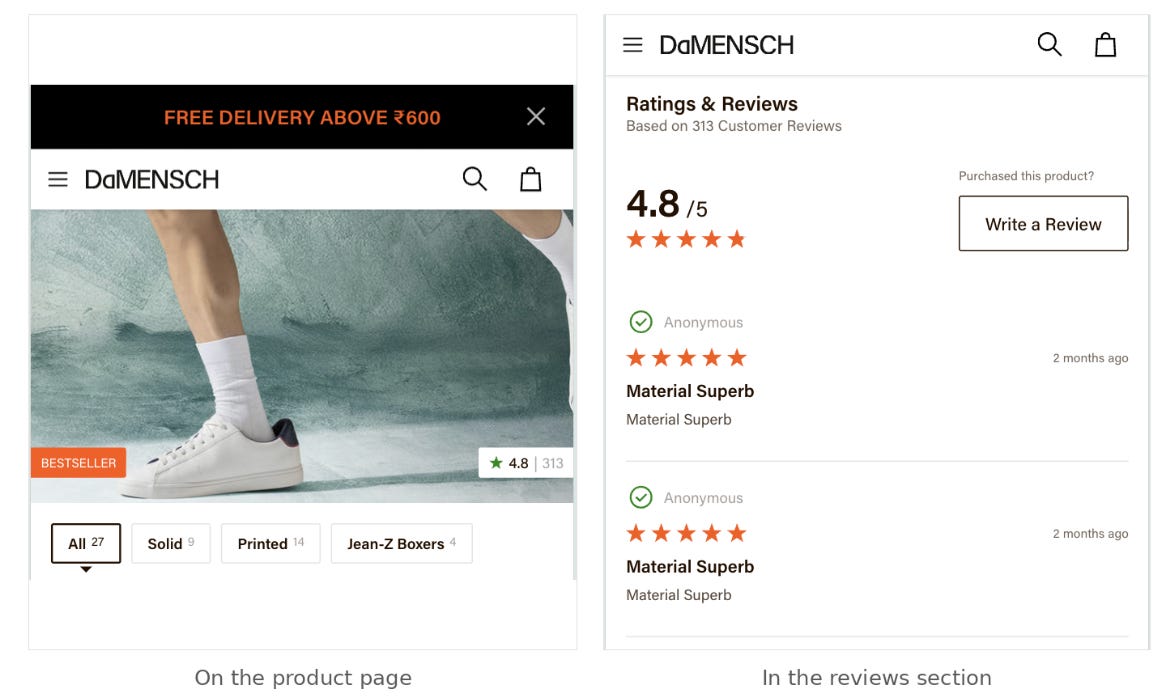
Start with DaMENSCH, because it shows the most reviews by far. Its counts run into the hundreds, up to 519 on the core innerwear. But two things hold it back. The marker rides on the product image rather than sitting by the title, so it reads more as decoration than as a claim. And the review module behind it is bare: no customer photos, no helpfulness votes, just a recency sort. A lot of reviews, presented flatly.
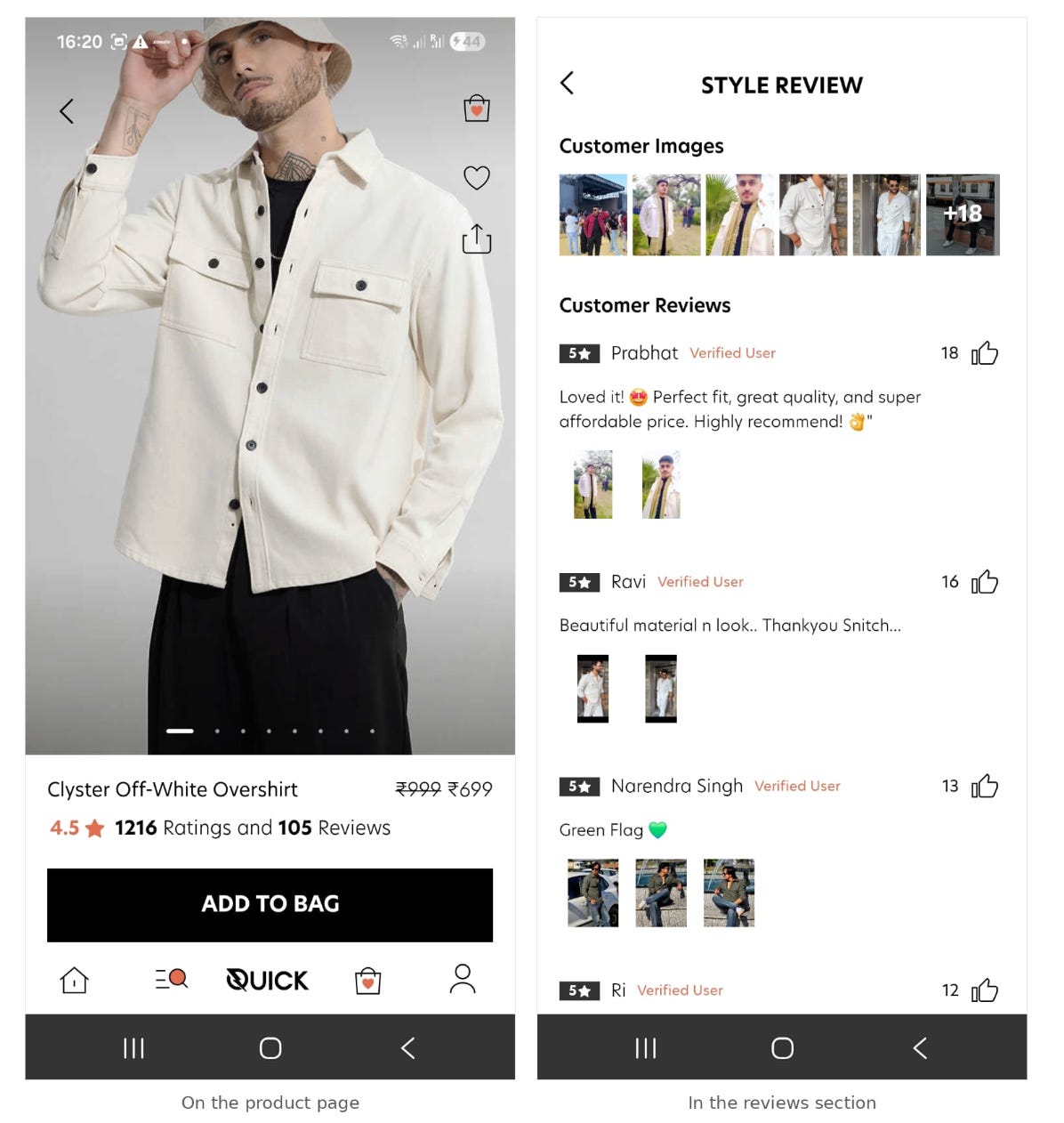
Snitch has the exact opposite problem: a better way to show reviews, but too few of them. It puts the rating right below the product title, where the decision gets made, and behind it runs the most capable review reader of the three, with a helpfulness thumbs-up and customer photos. Even so, it stops short of a complete one. There are no review tags, no filters, and no summary to orient a shopper who does not want to read every entry one by one. And the bigger gap is fuel. Most products carry only a handful of ratings, six on the shirt here, forty-six on the cargo pant. The best reader of the three is still half-empty, and a review section with almost nothing in it is still a thin page. That is what earns Snitch the round without earning it a good score: better structure than DaMENSCH, but incomplete, and underfed.
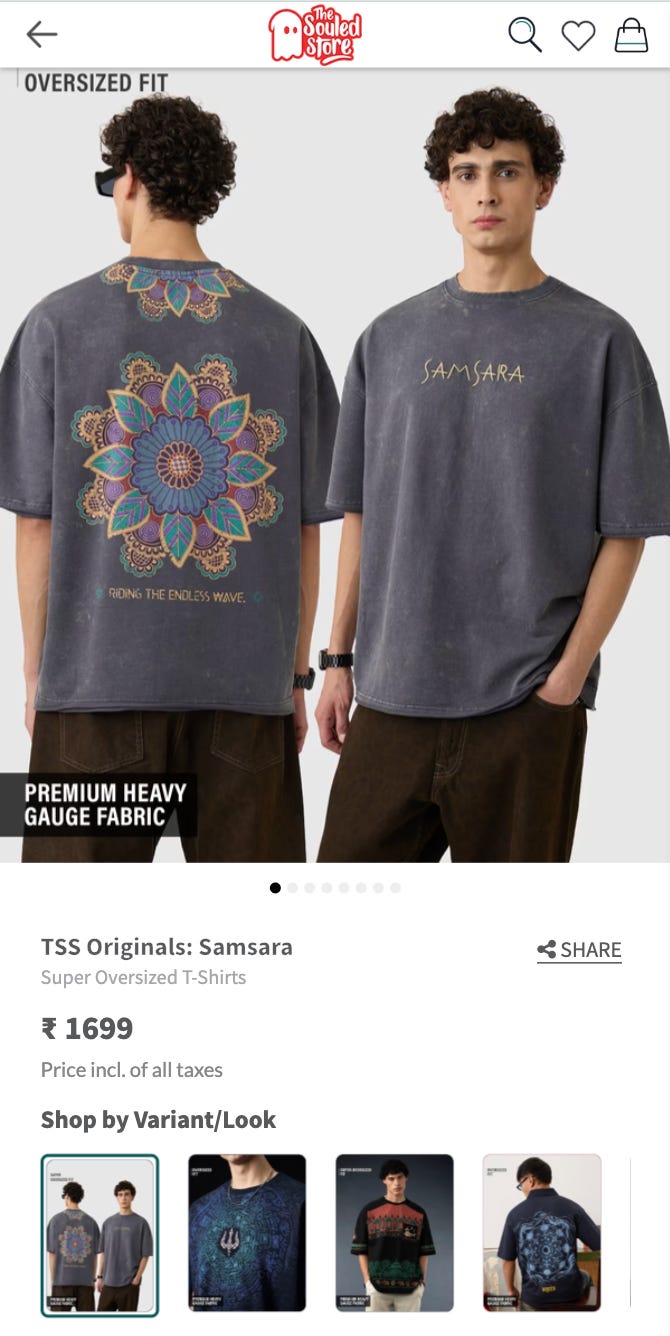
The Souled Store does not show product reviews at all: zero, on ten of ten pages, from a Spider-Man tee to an own-label solid. To be fair, this looks closer to a strategy than a lapse. Its pages carry twenty-five to forty-six photos apiece, proof by exhaustive depiction, visual certainty standing in for social certainty. When the character sells the shirt, that works, because the One Piece fan showed up already wanting it. But one detail should worry them. The ₹1,699 TSS Originals tee is the single most expensive product in this entire thirty-page study, and its page carries the least evidence that anyone has ever bought one. The no-reviews template was built for pages where Spider-Man is the social proof, and it is now being inherited by the own-label line, the exact products the growth story depends on, where it does the most damage.
So the round is two half-built answers and one refusal. DaMENSCH has the proof and shows it flatly. Snitch shows it well and barely has it. Each nailed the half the other fumbled, and neither managed both, which is why even the winner only reaches a 3.5. The Souled Store opts out entirely, handing away the cheapest trust on the page. And none of it is a per-product call: it is one template decision, made once and stamped on all ten SKUs.
Round 2 — Price & persuasion: who gives you a reason?
This round goes to DaMENSCH, on both price framing and copy, though the win comes with one caveat. On all ten pages it anchors hard: MRP struck through, a stated percentage off, then a coupon “BEST PRICE” below that. A boxer lists at ₹699, drops 16% to ₹589, and a coupon takes it to ₹442, with the saving spelled out in rupees, not just a percentage. That last detail matters more than it looks. Baymard’s testing finds shoppers act on whichever number looks bigger, and at Indian prices the rupee saving almost always beats the percentage: ₹110 off reads bigger than “16% off.” DaMENSCH is framing its discounts the way the research says works. The copy pulls its weight too. “3× softer than cotton.” “Odour-cancellation.” “Zero roll-up.” “Lasts longer.” Every line is a benefit rather than a spec, and several answer a specific doubt instead of just naming a feature. It is Claude Hopkins with a Shopify theme
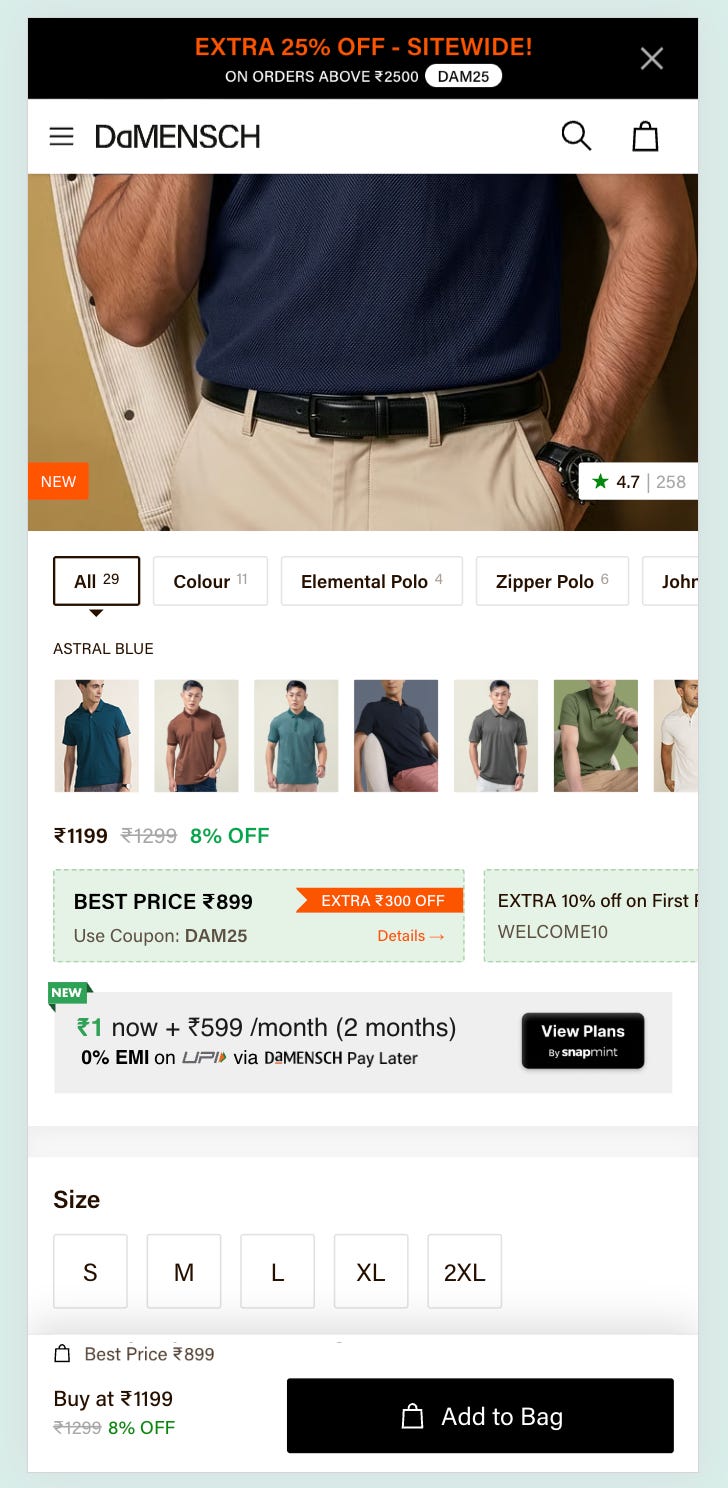
The caveat is that DaMENSCH may be stacking too much. A struck MRP, a percentage off, a coupon best-price, a WELCOME10, and a “25% off over ₹2,500” on the same screen is close to the pile-up Baymard flags as a common pricing pitfall, the point where a shopper stops being sure what is already applied and what still stacks. The anchoring is best-in-class. The layering is a whisker from confusing.
That stack is also the only real upsell engine in the study, and it is pure DaMENSCH. It is the one brand that turns the buy-box into a basket-builder: a best-price coupon, a first-order code, an “up to 15% off” tier, and 0% EMI on UPI through its own Pay Later. Snitch and The Souled Store offer none of it, no coupons, no financing, no nudge to add a second item. So DaMENSCH owns offers and payment outright, even as the same richness is what tips toward clutter.
Snitch's problem is not a missing anchor, it is what the anchor leaks. Take any single page and it mostly passes the textbook test: a struck MRP and a clear percentage off, the kind of display Baymard would wave through, apart from one overshirt that shows no MRP at all. It only ever states the percentage, never the rupees, so even in isolation it under-sells the saving the research says shoppers feel most. But the real damage is the thing no single-page check can catch. Line the ten pages up and the discounts run 7%, 30%, 20%, 10%, 0%, 30%, 13%, 30%, 30%, 30%. It is not random, it is two regimes: half the catalog at a flat 30% off, the rest scattered between 0 and 20%. That reads like fresh drops held near full price and aging stock marked to a house-standard 30, which means Snitch's sticker is not a price signal at all. It is an inventory-age signal wearing a price tag. Internally the logic is probably fine. Externally it is corrosive, because the shopper learns the pattern faster than you would expect: nothing at 7% is worth buying, and everything eventually hits 30. The discount structure is quietly training Snitch's own customers to wait, a system optimising stock turns at the direct expense of price trust.
Contrast that with The Souled Store’s clean refusal to discount. Flat pricing on ten of ten pages, not a single strikethrough anywhere: ₹899, ₹999, ₹1,199, ₹1,699, all full price. One brand’s sticker teaches you to wait; the other’s teaches you that the price is the price. Coherence, not discount depth, is what earns price trust.
And the copy at the cheaper end? Two of Snitch’s ten pages opened with the identical boilerplate sentence, “Maintain a timeless look as you transition between smart and casual,” spec-led filler reused across SKUs. The titles only describe (”Maroon Stripes Slim Fit Shirt”), and the IP titles only describe (”One Piece: Straw Hat”). Once again, only DaMENSCH’s page actually argues.
Round 3: Reassurance, or who makes it safe to click buy
Here the order flips — and Snitch comes last.
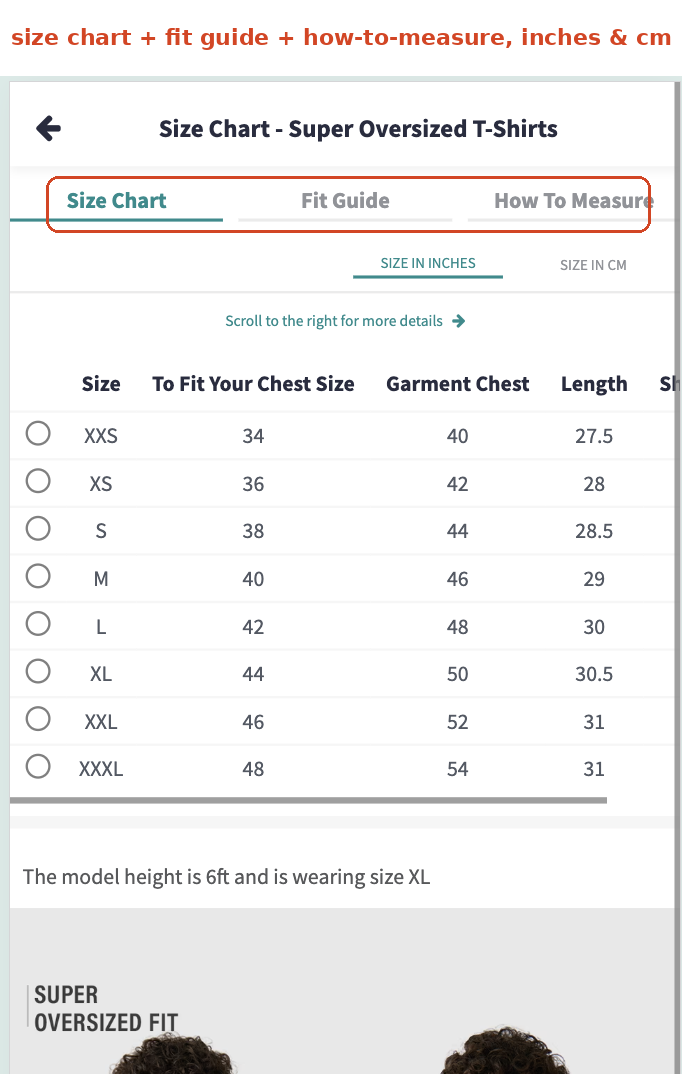
The Souled Store wins on risk reversal, and this is its redemption dimension. “30-day return or exchange, no questions asked,” shown as one plain, unconditional line on every page, alongside the best sizing experience of the three: a size guide with a fit guide and a how-to-measure tab, in inches and centimetres, XXS to XXXL, on all ten pages. For clothes bought online, that combination of generous returns and real fit help is the actual conversion engine, and it is the reason the no-reviews brand still finishes second.
The best sizing apparatus of the three — on every one of its ten pages.
DaMENSCH looks like it matches, with a “30-Day 1st Try Guarantee” badge on every page, but the badge oversells. Read the fine print and the 30 days covers only your first innerwear purchase, a single item, defects only; the everyday return is a separate “15-Day Easy Return” that excludes anything tried on or with its tags off, and the whole thing runs through a “chat with us” link rather than a self-serve flow. It is the same move as the offer stack: generous on the badge, hedged in the clauses. One honest sentence from Souled beats three reassuring badges that quietly shrink when you read them. That is the difference between reassurance and its appearance.
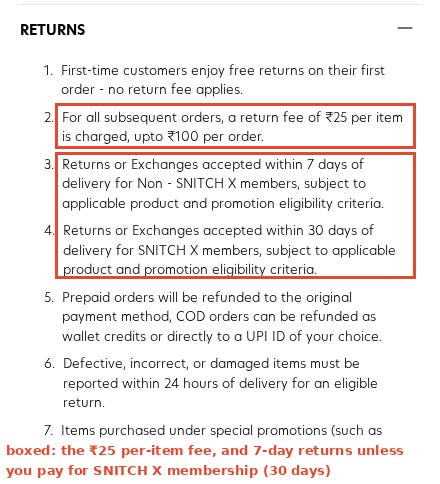
Snitch is the laggard, weak on both trust and sizing. It offers seven-day returns (thirty only if you are a paid SNITCH X member), a ₹25-per-item fee after your first order, and a size chart with no fit-finder and no "runs slim" signal at the moment you tap a size. And the policy itself is folded inside a collapsed accordion, nine numbered clauses a first-time shopper has to open and wade through, free returns on the first order only, fees after that, a 24-hour window to report a defect, whole categories excluded. Souled shows one sentence; Snitch makes you dig for nine. For the single biggest driver of apparel returns, that is the thinnest safety net of the three, and it is attached to trousers asking as much as ₹1,399.
The thinnest promise in the test, attached to the second-highest tickets.
And notice the inversion hiding in the price data. The Souled Store carries the highest average asking price of the three (around ₹1,134, versus Snitch's ~₹940 and DaMENSCH's ~₹792), and it pairs that with the most generous safety net in the study. Full price, fully de-risked: that is a coherent trade, and it is plausibly why the no-discount stance survives contact with the market. Snitch is the only brand here where price and reassurance pull apart, with four-figure tickets backed by the flimsiest promise. Those two curves have to move together, because every rupee of price is a rupee of the shopper's risk.
The scoreboard, and what each brand actually is
Three rounds down, here is the full tally across all thirty pages.
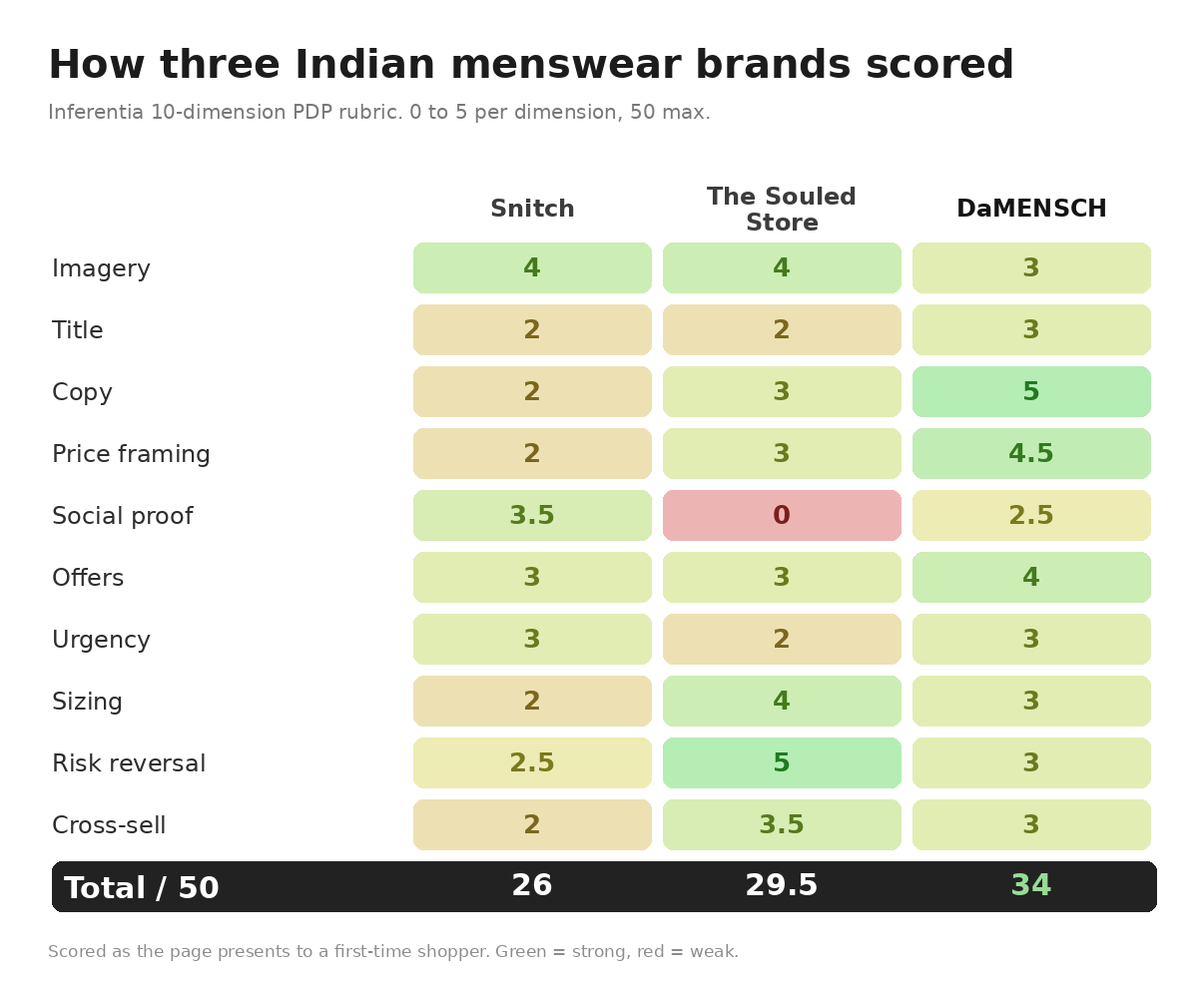
Averages across ten pages per brand. Per-SKU dimensions (imagery, title, copy, price) scored page by page; the other six are template-level and held constant across all ten pages per brand, more on why that matters below.
DaMENSCH, 34. The closer. It wins persuasion outright and never truly bombs a dimension, but it wins on argument, not polish: the rating buried on the product image, a returns badge that shrinks in the fine print, offers stacked to the edge of confusion. The most complete page in the test, and still sixteen points from complete.
The Souled Store, 29.5. The reassurer. It removes every ounce of purchase risk, one clean 30-day promise and the fullest fit help of the three, and it carries the highest average ticket while doing it. Then it shows zero social proof, on the own-label line that is now the majority of its sales. Second place on the safety net alone.
Snitch, 26. The merchandiser. It ships the best-looking pages in the category and the best-placed rating, then forgets to sell: incoherent pricing that trains buyers to wait, and the thinnest returns promise in the test, buried nine clauses deep. Third, despite leading the eye.
The real finding: you were not reading pages. You were reading templates.
Here is what only thirty pages could show me, and it is bigger than any round.
Score one page and you learn about that page. Score ten and you learn something stranger: almost nothing changes. Souled shows zero reviews on ten of ten, and discounts on none of ten. DaMENSCH parks its rating in the same spot on ten of ten. Snitch prices the same incoherent way across all ten. None of this is decided product by product. It is decided once, in the template, and stamped on everything the brand sells.
So the scoreboard above is not grading nine hundred separate choices. It is grading three templates.
That cuts two ways. If you are behind, the leak is everywhere, Snitch is not losing price trust on one unlucky page, it loses it on every page it has. But the fix is everywhere too. DaMENSCH’s rating sits on the product image instead of under the title. Move it, one change to one component, and every page it sells gets stronger the same afternoon. Nothing else in these companies improves that fast. A brand’s reputation shifts in years, a template shifts in a sprint. That is also why this ranking is shakier than it looks: these are gaps between three settings, not three fates.
Put a rupee figure on it, envelope math, stated assumptions. Snitch does roughly 60% of its ₹900 Cr online, call it ₹540 Cr flowing through this one template every year. If fixing the returns framing and the price incoherence lifts page conversion by even 5% relative, modest, against what the research attributes to trust signals alone, that is roughly ₹27 Cr a year. The cost of capturing it is one sprint and three sentences of copy. There is no other ₹27 Cr in that company available at that price.
But go one level deeper. A template does not just repeat your decisions, it repeats your assumptions, silently, onto every product you will ever launch, including the ones those assumptions no longer fit.
At DaMENSCH, that is currently a tailwind. The BESTSELLER badge splits the catalog perfectly: every boxer and vest carries one, no tee or polo does. Core innerwear piles up hundreds of reviews, the new topwear sits at 13 to 59. That is an expansion map, readable straight off the badges, topwear riding a trust apparatus the innerwear earned. The template is lending credibility across categories.

At The Souled Store, the same thing happens, but backwards. Showing no reviews made sense when every page had Spider-Man on it, because the character is the proof. But the template cannot tell a Marvel tee from a ₹1,699 own-label design, so it stays silent on both. That silence was fine for licensed products. It is a problem for the own-label line, and that line is now more than 55% of sales. So the brand is running its no-proof template on the bigger half of its business. Same pattern as DaMENSCH, opposite result.
That is what a product-page template really is. Not a design file, but a snapshot of what the company believed when it built the page. DaMENSCH’s says we sell to skeptics. Souled’s says we sell to fans. Snitch’s says the feed already sold them. Each was true once. The scoreboard is just measuring how true it still is.
One last note from the scoring. Pricing is the only dimension that really changes from one product to the next. Look at a single full-price Snitch page and the brand looks like it never discounts. Look across ten and it discounts constantly, in two patterns no single page shows you. So nine of the ten dimensions you can judge from one good page. Price you have to check across many, or the page you happen to open will mislead you about the rest.
The Frankenstein PDP, and the five points nobody owns
Assemble the perfect Indian apparel page from what these three already do best, and it builds itself. Snitch’s gallery: deep, model-on-body, seven colourways as full looks. DaMENSCH’s buy-box: rating under the title, MRP anchor, benefit-led copy, stacked offers with rupee savings. Souled’s safety net: 30-day no-questions returns and a real fit guide.
Every component already exists, live, on an Indian D2C page today. Nobody has put them on the same page.
Now the humbling part. Take the best score any brand earned on each dimension and the composite reaches only 45 of 50. Best-in-class everything, five points short. Because nobody has cracked urgency (3, 2, 3 across Snitch, Souled, DaMENSCH) or cross-sell (2, 3.5, 3). The two levers that move a shopper now and grow the basket sit unclaimed, not just by these three but, on this evidence, by the category.
Cross-sell shows the pattern in miniature. Souled has the most relevant version, a “Pair It With” strip, an “Others Also Bought” row, but it sits mid-page and only links out. DaMENSCH builds the best cards, rating, price, Add to Bag on each, then buries the row below the reviews. Snitch does the least: nothing in the app, a generic carousel on mobile web. Relevance, placement, a save-for-later: three brands, and no page has all three. Each built a different third of the lever.
And here is the irony buried in the urgency scores. The most honest urgency claim in Indian fashion already exists, Snitch built it. Snitch Quick delivers in 60 minutes in Bengaluru, with a national rollout underway. “Your date is at 8, this shirt arrives by 7” is real urgency: no fake countdown, no manufactured scarcity, just a true fact about time. On the pages I scored, that promise was nowhere in the buy-box. Snitch spent real money building the one urgency lever no competitor can fake, and its own product page does not pull it.
So the Frankenstein page is not the ceiling. It is only the best anyone has proven possible. The last five points are open whitespace, and the first brand to claim them will not be copying anyone.
One thing nobody loses on: photography. Snitch averages around eight images a page, Souled around thirty-five, DaMENSCH sixty-plus. Indian D2C has fully solved the picture, which is exactly why the picture no longer wins anything. The contest has moved into the buy-box and the trust layer, and that is where two of these three are still bringing a thumbnail to a knife fight.
The steelman: every flaw has a receipt
Before the fix list, be fair to these teams. I scored thirty pages from the shopper’s side of the screen. Score them from the CFO’s side and each brand’s worst dimension stops looking like a blind spot and starts looking like a decision with a receipt attached.
Snitch’s stingy returns are RTO defense. Indian fashion e-commerce returns 25 to 35% of what it ships, COD orders touch 40%, and each failed delivery costs the brand ₹150 to 300 in two-way logistics on zero revenue, an ₹8,000 Cr annual hole for the category. Many shoppers bracket: order three sizes, keep one. A ₹25 fee and a seven-day window are not laziness, they are a tax on serial returners. The template’s failure is that it cannot tell a serial returner from a first-time full-price buyer, so it points the same defensive crouch at both. The fix is not generosity. It is segmentation, and one sentence of tone. The first return is free at Snitch, the page just buries that lead under nine clauses of suspicion.
The Souled Store’s flat pricing and silent pages smell like contract, not conviction. Licensed merchandise runs on licensor terms: character-licensing deals in India carry royalties in the low double digits on sales, minimum guarantees, approval rights over how characters appear, and often explicit terms around discounting, because Marvel does not want Iron Man in the clearance bin. Never a strikethrough on ten of ten pages may be less a pricing philosophy than a clause. Which makes the own-label problem sharper, not softer: TSS Originals is bound by none of it. No royalty, no approval rights, no discount restrictions, and the template still treats it like licensed goods. The fossil is not just an old belief. It is an old contract, applied to products that never signed it, and those products are now the majority of the business.
DaMENSCH’s offer pile-up is survival math. The company lost ₹57 Cr on ₹118 Cr of revenue in FY25. When every visitor arrives off a paid ad, the coupon stack, the first-order code, the EMI, that is a loss-making brand squeezing AOV and conversion out of traffic it paid cash for. The clutter is not sloppiness, it is triage. It just happens to be triage the shopper can see.
None of this changes the scores. A defensible cost decision is still a conversion leak, the shopper feels the crouch, the silence, the clutter, whatever the spreadsheet behind it says. But it changes the prescription. You do not fix these pages by telling the CFO he is wrong. You fix them by finding the version of the same decision that does not show.
Why the gaps persist, and the Monday-morning fix list
None of these PDPs was built for a first-time comparison shopper. Each was built for the shopper its acquisition engine already delivers. Snitch’s buyer arrives pre-persuaded by the feed, so the page never learned to argue, it merchandises. Souled’s buyer arrives a fan, pre-sold by the licence, so the page never learned to prove, it reassures. DaMENSCH’s buyer arrives off a performance ad, skeptical, comparison-shopping ₹400 boxers, so the page had to close. These gaps are not oversights. They are each brand’s acquisition model showing through the HTML. And they persist because every page works fine for the traffic it was built for, and quietly bleeds the traffic it was not.
Notice where the money went. Photography, solved by all three, is the expensive layer: shoots, models, studios, every drop, forever. The buy-box, unsolved by two of three, is the cheap one: a template edit and three sentences of copy. The category is over-investing in the solved, expensive layer and under-investing in the unsolved, nearly free one.
Because these are template settings, every fix below is one edit that upgrades the entire catalog at once.
Snitch: lead with “first return free” in one plain sentence above the fold, the policy already exists, only the suspicion is showing; add rupee savings next to the percentage; put Snitch Quick’s 60-minute promise in the buy-box wherever it is live, it is the only urgency claim in Indian fashion that is simply true.
The Souled Store: turn reviews on for TSS Originals before the own-label line scales any further, the licensing logic that justified silence does not apply to your own products, and the first five reviews are worth a roughly 270% swing in purchase likelihood, largest at exactly your price points.
DaMENSCH: move the rating from the image to under the title; collapse the five simultaneous offers into two; make the everyday return policy match the badge, or change the badge.
If you run a product page, forward this to whoever owns your template. The fix ships before Friday.
Next edition: one brand, one surface, the same rubric. Subscribe to get it when it drops.
Scored against the Inferentia 10-Dimension PDP Rubric v1 (0 to 5 per dimension, 50 max). Thirty pages, ten per brand, pulled live 21 to 22 Jun 2026 across each brand’s actual catalog: Snitch shirts, trousers, overshirts; Souled licensed-IP and own-label tees, polos, vests; DaMENSCH boxers, vests, tees, polos. Per-SKU dimensions measured on every page; template-level dimensions confirmed constant across all ten pages per brand. Elements buried in accordions are scored on their placement, because buried is a choice. Scores are Inferentia rubric judgments, not the brands’ own metrics. Revenue and funding figures: Snitch FY26 (~₹900 Cr, up ~80%) and The Souled Store FY25 (₹492.4 Cr, net profit ₹11 Cr) per Inc42; DaMENSCH FY25 (₹118 Cr, net loss ₹57 Cr) and Snitch Series B (₹279 Cr at ₹2,500 Cr valuation) per Entrackr; Souled Store own-label share (55%+ of sales) per The Ken. Review-conversion data per the Spiegel Research Center, Northwestern University. RTO and returns figures per industry logistics reporting on Indian e-commerce. Licensing royalty structure per Apparel Resources’ reporting on Indian character licensing.
Disclaimer: This is an independent editorial analysis. The scores and opinions here are the author's own, based on each brand's product pages as they appeared when scored (21 to 22 June 2026). Pages change, and any brand's live pages may now differ. Inferentia is not affiliated with, sponsored by, or endorsed by Snitch, The Souled Store, or DaMENSCH, and no trademark owner has authorised this piece; brand names and screenshots are used for the purpose of review and commentary. Financial and funding figures are attributed to the third-party sources cited above and were not independently audited. If any brand believes a factual point is inaccurate, write to us and we will review and correct it, and are glad to publish a response.